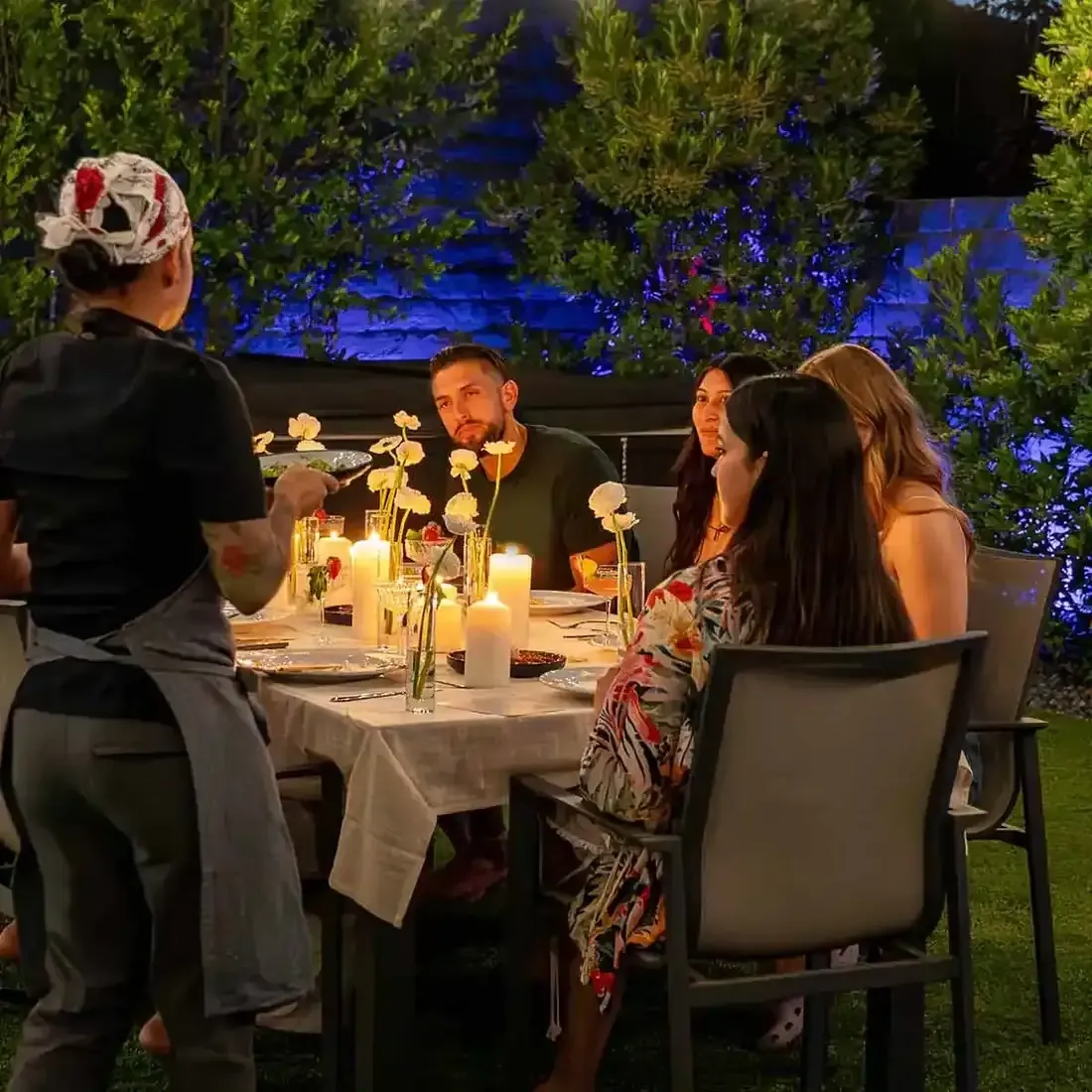
Marco Reyes arrives at a stranger's house at four in the afternoon and turns their kitchen into his own in under an hour. The knives come out of a rolled canvas case, lined up by length. A folding prep table goes against the island. By five the counters are mapped - proteins here, garnishes there, a quiet corner for plates warming in the oven - and the home, for one evening, belongs to him.
He has done this in penthouses on the Strip and in a ranch house outside Pahrump with a stove that ran on propane. The kitchen is never the one he would have chosen. That, he says, is rather the point.
- Origin
- Oaxaca, Mexico
- Training
- Pujol, Mexico City; then four years on the line in Chicago
- Background
- Nine years in Michelin dining rooms
- Based
- Las Vegas, since 2022
- Known for
- Live-fire tasting menus built for rooms of eight to twelve
- Cootoh rating
- 4.96 across 140 dinners
Leaving the dining room
For most of his twenties, Reyes cooked in rooms designed to be looked at. There was the marble, the lighting consultants, the maître d' who could read a table's mood from across the floor. The food was extraordinary and the food was, he came to feel, almost beside the point - one element in a performance the guest had paid handsomely to sit inside.
You spend years getting a single dish exactly right, he says, and then it crosses a dining room that's doing ninety percent of the talking before the plate even lands. He doesn't say this with bitterness. He says it the way someone describes weather they've decided to stop fighting.
In a restaurant, the room is the product. In someone's home, the food is the only thing on stage. There's nowhere for it to hide.
Marco Reyes
The shift, when it came, was less a decision than a relief. A friend asked him to cook for eight people at a birthday dinner. He spent a week on a menu he'd never have been allowed to run in a restaurant - too personal, too slow, too dependent on a single farmer's spring onions. The guests didn't applaud. They went quiet, which he has since learned is the better compliment. By the end of the night he had three more dinners booked and a clear sense of what he wanted to do with the next decade.
What he carries
The traveling kitchen fits in the back of a station wagon. Knives, a few pans he trusts, a portable grill for the live-fire courses, and a cooler that he treats with more care than anything else he owns. What's inside the cooler is the menu, and the menu is decided less by Reyes than by whoever picked up his call that week.
He keeps a short list of growers and fishmongers, most of whom don't advertise and a few of whom he won't name on the record. The relationships took years and a great deal of showing up at six in the morning. They are, functionally, the thing a client is paying for: access to ingredients that never reach a menu printed in advance, because no one knows on Monday what Thursday will be worth cooking.
I don't write the menu and then go shopping. I go shopping, and the menu writes itself on the drive home.
Marco Reyes
This is the part that sounds like a luxury and is really a discipline. Cooking to what exists, rather than to what was promised, means a great deal of work is invisible to the guest by design. The sourcing calls, the cold chain, the timing math that gets twelve plates to the table at once from a kitchen that wasn't built for it - none of that is meant to be seen. If you notice the effort, he says, I've done something wrong.
Why Las Vegas
People assume he came for the restaurants, or for the money, and are surprised when he says he came for the desert. Las Vegas sits inside one of the more interesting growing regions in the country if you know where to look - short, intense seasons, farms in Pahrump and the Moapa Valley, a window for stone fruit and chiles that most of the map can't match.
There is also the matter of the rooms. The city is full of houses built for people who entertain - long tables, open kitchens, terraces that hold a dozen without strain - and full of people newly arrived at a life they are still learning how to host inside of. Reyes is, in a sense, in the business of effortlessness: making the evening feel like it simply happened, when in fact it was assembled over a week of phone calls.
Everyone here is building something. I get to cook the night they decide to stop and look at what they have built.
Marco Reyes
He works through Cootoh now, which handles the parts of the evening he was never good at - the scheduling, the dietary questions, the logistics that used to eat the days between dinners. It leaves him with the cooler, the drive home, and the menu that writes itself. Which is, by his own accounting, the only part he ever wanted.
By eleven the kitchen is his again only in the sense that it is the one he is cleaning. The knives go back in the canvas case by length. The folding table comes down. The home returns to its owners, who are usually still at the table, still talking, in no hurry for him to leave. He lets himself out quietly. That, too, is the point.